 Skip to content

Bobbin Heater Element
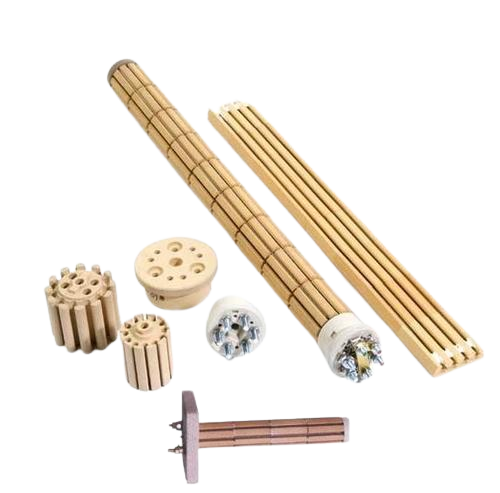

Ceramic bobbin heating elements
Sanvi Heat Ceramic bobbin heating elements are engineered for direct air heating and indirect heating of liquids and gases in industrial vessels, tanks, and pipe systems. Constructed from high-precision cylindrical porcelain blocks assembled to specified lengths, these units house premium Nichrome resistance wire to deliver reliable thermal energy across continuous operating cycles.. Connect | Contact
What is a Bobbin heater element?
As the name suggests, bobbin heaters are made of ceramic blocks with a high dielectric strength called bobbins. These bobbins come in a range of diameters and lengths, and they are composed of high-temperature insulators. They are interconnected to achieve the necessary power and length.
What are the uses of Bobbin Heating Element?
Bobbin heaters are further placed into a route in the tank or system and are mostly used for indirect heating of gas and liquids and direct heating of air. Because all of the heat generation occurs within the solution, they are incredibly energy-efficient.
The ceramic bobbin heaters can also be equipped with additional controls and temperature gauges for accurate temperature control and detection. It may be used to directly heat the air on its own (without the radiant tube).
The major uses for bobbin type heaters, which are commonly used with external pipes for gas and oil heating, are their high efficacy and ease of replacement.
Offer for materials like bitumen, wax, and fats that are semi-solid yet liquid at room temperature. Suitable for indirect heating of gases and liquids; it may be replaced or maintained without overflowing the process tank by connecting it to a pocket or protective tube within the tank.
Benefits of Bobbin heater element
- Ideal for heating furnaces at low temperatures of up to 600 °C
- Different lengths, voltages, and powers are available to meet the individual demands of the users.
- Installation is inexpensive and easy.
- The ease of upkeep and repairs
- Non-toxic and versatile
- It is energy-efficient as all of the heat generated remains inside the solution.
Construction & Design
- Precision Porcelain Assemblies: Interlocking ceramic blocks form a stable column that holds the internal wiring in place while resisting thermal shock and electrical degradation.
- Nichrome Resistance Wire: High-grade wire is threaded through the ceramic channels to maintain uniform spacing, ensuring consistent heat output and preventing internal short circuits.
Flexible Configurations: Manufactured in single-core and multi-core patterns across both cylindrical and rectangular profiles to match specific vessel dimensions.
Performance Characteristics
- Indirect Thermowell Mounting: Designed to fit inside steel wells, pockets, or protective sheaths. This allows operators to service or replace heating elements without draining tanks, breaking fluid seals, or interrupting production flow.
- Low Watt Density: Operates at low surface power density to prevent burning, scorching, or fluid degradation in heat-sensitive liquids and oils.
- High Thermal Efficiency: Optimizes heat transmission from the internal resistance wire through the ceramic structure and outer sleeve, lowering energy consumption.
- Economical Installation: Simple drop-in assembly reduces initial mounting costs and simplifies ongoing equipment maintenance.
Common Applications
Indirect liquid heating in storage tanks, boilers, and oil vats
Industrial forced-air heating and duct systems
Process heating equipment, drying ovens, and hot water storage units
Feature / Parameter Standard Specification
Thermowell Sheath Material Options
Bobbin elements are inserted into protective metal tubes or pockets depending on the process medium:
- Mild Steel: Suitable for general oil heating, bitumen, and non-corrosive liquids.
- Stainless Steel 304: Standard option for water, food processing, and mild chemicals.
- Stainless Steel 316L: Used in corrosive chemical environments, marine settings, and acid solutions.
- Incoloy 800 / 840: Recommended for high-temperature fluid heating and aggressive industrial solutions.
Electrical Terminals & Connections
Connection Types: Threaded studs (M4/M5), ceramic terminal blocks, or high-temperature insulated nickel lead wires.
Wiring Configurations: Star or Delta configurations for 3-phase power distribution.Terminal Housing: Standard IP54 or IP65 terminal enclosures mounted to the outer protection sheath flange.
Key Benefits
Zero Process Interruption: Because bobbin heaters slide directly into steel thermowells or protection sheaths, technicians can inspect or replace the electrical core without draining storage tanks, opening pressure vessels, or halting plant operations.
Fluid and Chemical Isolation: The resistance wire never contacts the liquid or gas directly. This physical barrier protects the heating circuit from chemical attack, scaling, acid corrosion, and mechanical damage.
Scorch-Free Heating: Low surface watt density distribution prevents localized hot spots. This makes bobbin elements suitable for heat-sensitive fluids like oils, food liquids, asphalt, and specialty chemicals that burn or carbonize under extreme heat.
Extended Service Life: High-purity steatite ceramic bodies offer thermal shock resistance and high dielectric strength. Keeping the Nichrome wire dry and uniformly supported inside ceramic channels reduces thermal stress and oxidation.
Lower Replacement Costs: Replacing an old ceramic core is significantly cheaper than replacing a complete direct-immersion flange heater assembly or discarding welded thermowell hardware.
Customizable Configurations: Modular porcelain blocks allow manufacturers to adjust element lengths, voltages, power ratings, and circuit setups (single-phase or three-phase) to match exact tank geometries.
Ceramic Bobbin Heater V/s Tubular Heating Element
| Feature | Ceramic Bobbin Heater | Tubular Heating Element |
| Heating Method | Indirect heating through a protective thermowell or sheath | Direct immersion or surface contact heating |
| Maintenance & Service | Core element replaces without draining tanks or stopping process flow | Requires draining the vessel or unmounting the sheath assembly |
| Internal Insulation | High-purity ceramic blocks supporting open wire coils | Compacted Magnesium Oxide (MgO) powder sealed in a metal tube |
| Watt Density | Low watt density (1.5 to 3.5 W/cm²) to protect delicate fluids | Medium to high watt density (up to 10+ W/cm²) |
| Custom Shaping | Straight, rigid cylindrical or rectangular assemblies | Highly formable, can be bent into complex 2D and 3D shapes |
| Fluid Contact | Elements never makes contact with the process media | Outer metal sheath touches liquid, air or solid directly. |
When to Choose a Ceramic Bobbin Heater?
- Large Storage Tanks: Essential for bulk storage where draining thousands of liters of fluid during heating element replacement is costly or impractical.
- Heat-Sensitive Liquids: Preferred for viscous oils, asphalt, bitumen, and chemical solutions that degrade or scorch under high watt densities.
Corrosive Environments: Allows engineers to install specialized corrosion-resistant thermowells (such as SS316L or Incoloy) while keeping standard electrical components dry and isolated inside.
When to Choose a Tubular Heater?
- Fast Heat Transfer: Ideal for direct water immersion, air ducts, and metal block heating where maximum heat transfer speed is required.
- High Power Output: Suitable for compact equipment requiring high thermal output in limited spaces.
- Custom Enclosure Shapes: Recommended when heating elements need to wrap around pipes, fit curved vats, or conform to custom machinery footprints.
Why choose us?
Get through the wholesome experience of heating solutions with us. We promise to bring ease in your life with our best Aluminium cast heaters.
We ensure that you get the best service possible so don’t think and provide yourself the best heating solution with us.
