Skip to content
Finned Resistors – In industrial heating systems, dissipation efficiency is the boundary between peak performance and equipment failure. When a system needs to dissipate significant electrical energy as heat—or conversely, generate forced-air heat reliably—standard smooth-surface heating elements often fall short. They struggle with low convective heat transfer coefficients due to the poor natural thermal properties of airflow (Zhang et al., 2022).
This is where Sanvi Heat finned resistors Sanvi Heat solutions (commonly referred to in heavy industry as finned tubular heating elements) become essential. By engineering artificial roughness and physical extensions onto the resistor body, these components fundamentally rewrite the physics of industrial thermal management (Singh, 2025).
Here is everything you need to know about selecting, utilizing, and maximizing the lifetime of ARI finned resistors.
What is an ARI Finned Resistor?
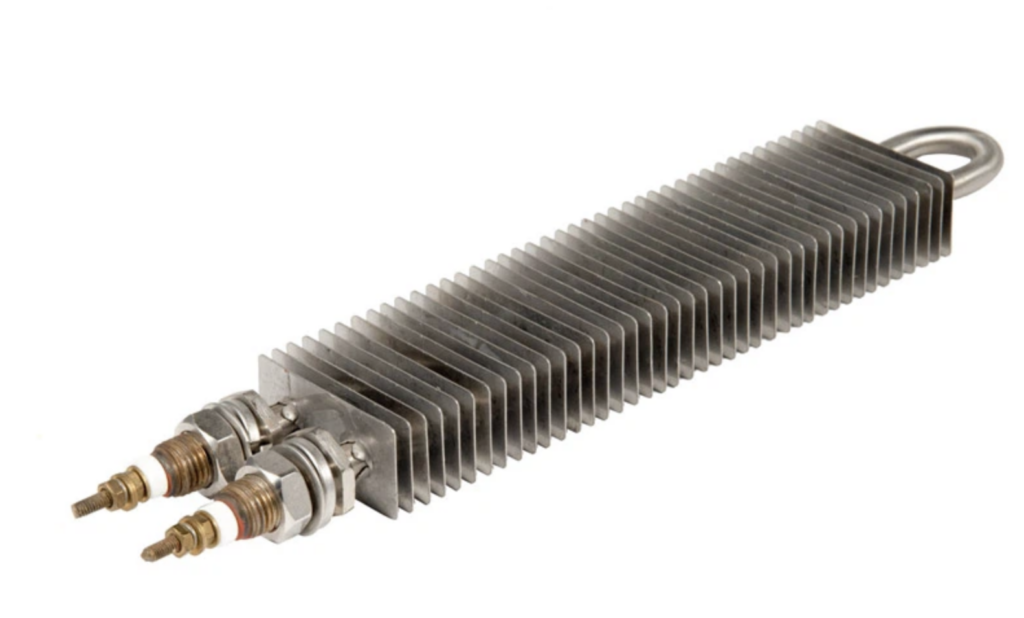
An ARI finned resistor is a heavy-duty electrical resistance heating element or power dump resistor encased in a protective metal sheath, wrapped tightly with continuous metallic fins.
The primary engineering challenge in air-heating and electrical load dissipation is thermal resistance on the air side (Zhang et al., 2022). Air is an excellent insulator; without a massive surface area, a resistor will overheat internally before it can effectively transfer its heat to the surrounding environment.
By adding spiral or rectangular fins, ARI resistors increase the effective surface area by up to 300% or more, drastically lowering the air-side thermal resistance and allowing the unit to run cooler while outputting the same wattage.
How ARI Finned Resistors Overcome the “Air-Side” Bottleneck
In standard thermal design, the overall rate of heat transfer is governed by the surface area available and the fluid dynamics of the air flowing past it (Taler, 2010). ARI finned resistors use two core thermodynamic mechanisms to maximize performance:
1. Drastic Surface Area Extension
The total rate of heat transfer (Q) is directly proportional to the surface area (A). By packing tightly wounded fins along the longitudinal axis of the resistor tube, manufacturers cram maximum surface area into incredibly tight geometric footprints.
2. Boundary Layer Disruption
Smooth tubes allow air to glide over them symmetrically, creating a stagnant “viscous sublayer” of hot air that acts as a thermal blanket, choking heat transfer. The sharp contours of ARI finning act as artificial roughness ribs. This configuration disturbs the airflow, breaking up smooth (laminar) flow and creating turbulent eddies (Singh, 2025). This turbulence strips away the insulating boundary layer and boosts convective heat transfer (Singh, 2025).
Key Technical Specifications
When sourcing Sanvi Heat ARI finned resistors for load banks, duct heaters, or industrial drying equipment, match your system parameters against these critical material choices:
Here is a comprehensive, SEO-optimized B2B article tailored for industrial heating equipment manufacturers, engineers, and distributors. This piece is structured to rank for high-intent search queries surrounding “ARI finned resistors” and “finned heating elements.”
Maximize Thermal Efficiency: The Ultimate Guide to ARI Finned Resistors
In industrial heating systems, dissipation efficiency is the boundary between peak performance and equipment failure. When a system needs to dissipate significant electrical energy as heat—or conversely, generate forced-air heat reliably—standard smooth-surface heating elements often fall short. They struggle with low convective heat transfer coefficients due to the poor natural thermal properties of airflow (Zhang et al., 2022).
This is where ARI finned resistors (commonly referred to in heavy industry as finned tubular heating elements) become essential. By engineering artificial roughness and physical extensions onto the resistor body, these components fundamentally rewrite the physics of industrial thermal management (Singh, 2025).
Here is everything you need to know about selecting, utilizing, and maximizing the lifetime of ARI finned resistors.
What is an ARI Finned Resistor?
An ARI finned resistor is a heavy-duty electrical resistance heating element or power dump resistor encased in a protective metal sheath, wrapped tightly with continuous metallic fins.
   [Electrical Terminals] ---> [=============================]  <-- Stainless Steel Sheath
                                |||||||||||||||||||||||||||||
                                ^^^^^^^^^^^^^^^^^^^^^^^^^^^^^   <-- Helical / Spiral Fins
The primary engineering challenge in air-heating and electrical load dissipation is thermal resistance on the air side (Zhang et al., 2022). Air is an excellent insulator; without a massive surface area, a resistor will overheat internally before it can effectively transfer its heat to the surrounding environment.
By adding spiral or rectangular fins, ARI resistors increase the effective surface area by up to 300% or more, drastically lowering the air-side thermal resistance and allowing the unit to run cooler while outputting the same wattage.
How ARI Finned Resistors Overcome the “Air-Side” Bottleneck
In standard thermal design, the overall rate of heat transfer is governed by the surface area available and the fluid dynamics of the air flowing past it (Taler, 2010). ARI finned resistors use two core thermodynamic mechanisms to maximize performance:
1. Drastic Surface Area Extension
The total rate of heat transfer (Q) is directly proportional to the surface area (A). By packing tightly wounded fins along the longitudinal axis of the resistor tube, manufacturers cram maximum surface area into incredibly tight geometric footprints.
2. Boundary Layer Disruption
Smooth tubes allow air to glide over them symmetrically, creating a stagnant “viscous sublayer” of hot air that acts as a thermal blanket, choking heat transfer. The sharp contours of ARI finning act as artificial roughness ribs. This configuration disturbs the airflow, breaking up smooth (laminar) flow and creating turbulent eddies (Singh, 2025). This turbulence strips away the insulating boundary layer and boosts convective heat transfer (Singh, 2025).
Key Technical Specifications
When sourcing ARI finned resistors for load banks, duct heaters, or industrial drying equipment, match your system parameters against these critical material choices:
| Parameter | Standard Offerings / Materials | Engineering Purpose |
|---|---|---|
| Sheath Material | 304/316 Stainless Steel, Incoloy, Carbon Steel | Dictates corrosion resistance and maximum operating temperature. |
| Fin Material | Stainless Steel, Aluminum, Copper | Aluminum offers superior thermal conductivity; Stainless steel handles corrosive/high-heat environments. |
| Fin Geometry | Spiral/Helical wrap, Rectangular plate, Plain corrugated | Determines pressure drop along the air duct and total turbulence. |
| Watt Density | Generally 20 to 50 W/in2(dependent on airflow) | Higher airflow allows for greater watt density without burning out the element. |
Critical Applications in Heavy Industry
Thanks to their high power dissipation capacity and robust mechanical construction, ARI finned resistors are widely deployed across several critical sectors:
- Load Banks & Power Dumping: Used to safely dissipate massive electrical overloads in generator testing, dynamic braking for trains/elevators, and renewable energy grids.
- Forced Air Duct Heating: Positioned inside HVAC ducts and industrial ventilation systems to provide rapid, uniform comfort or process heating.
- Industrial Drying & Curing Ovens: Utilized in automotive paint booths, textile manufacturing, and food processing plants where high-volume, uniform moisture evaporation is required.
- Enclosure and Anti-Condensation Heating: Low-wattage versions keep critical control panels and electronic switchgear moisture-free in humid maritime or outdoor settings.
Installation & Maintenance Best Practices
To ensure your ARI finned elements achieve their maximum operational lifespan, implement these engineering safeguards:
1. Maintain Minimum Air Velocity
Finned resistors rely heavily on forced convection. If your blower fan fails or airflow drops below minimum thresholds (typically 2 to 4 m/s), the elements will experience rapid thermal runaway. Always interlock the resistor’s electrical supply directly with the fan motor starter.
2. Watch the Pressure Drop
While more aggressive fin profiles boost heat transfer, they also introduce a higher fluid pressure penalty along the duct (Ferhati et al., 2015; Zhang et al., 2022). Ensure your system’s fan curve can handle the static pressure drop introduced by a dense bank of finned elements.
Summary: Choosing the Right Element
ARI finned resistors provide an efficient, robust solution for applications demanding high-wattage dissipation and rapid thermal exchange. By matching the right sheath metallurgy, fin geometry, and watt density to your specific airflow conditions, you ensure long-term system reliability and minimize costly downtime.
References
- Ferhati, A., Karayiannis, T. G., Lewis, J. S., McGlen, R. J., & Reay, D. A. (2015). Single-phase laminar flow heat transfer from confined electron beam enhanced surfaces. Heat Transfer Engineering, 36(12), 1165-1176. https://doi.org/10.1080/01457632.2015.994457
Singh, P. (2025). Performance evaluation of a triangular-finned absorber plate solar air heater: A theoretical and experimental study. Evergreen, 12(3), 1736-1751.
Zhang, L., Wang, J., Liu, R., Li, G., Han, X., Zhang, Z., Zhao, J., & Dai, B. (2022). Numerical study of fin-and-tube heat exchanger in low-pressure environment: Air-side heat transfer and frictional performance, entropy generation analysis, and model development. Entropy, 24(7), 887. https://doi.org/10.3390/e24070887