Skip to content
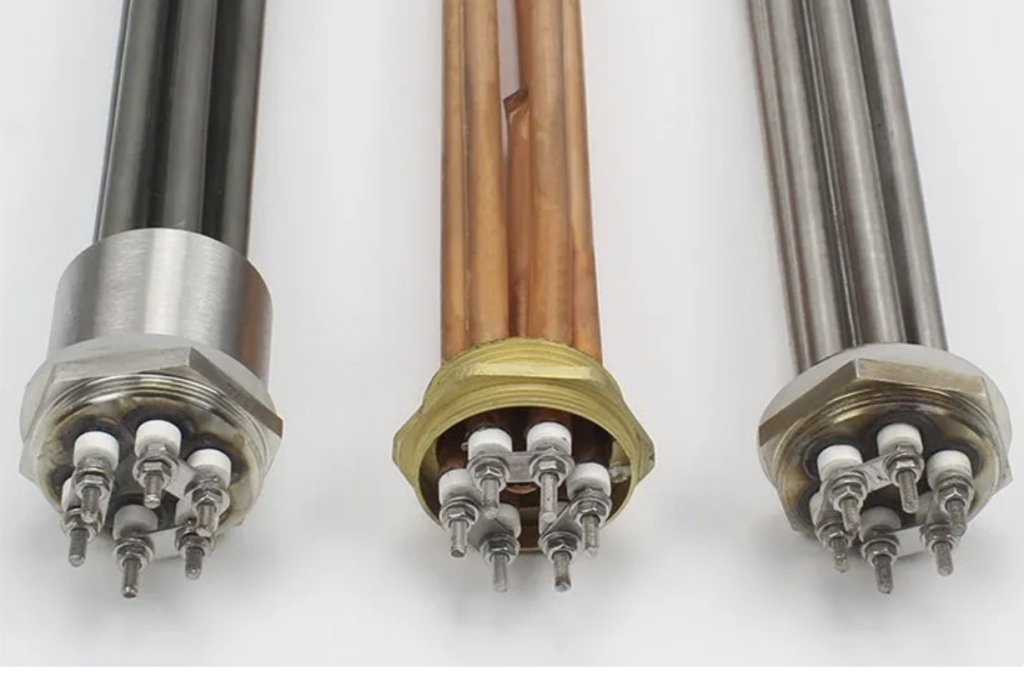
When you look at compact, direct immersion heating, screw plug heaters are usually the baseline standard for a reason. The mechanical design is straightforward: hairpin tubular elements are welded or brazed into a threaded pipe plug. You screw them directly through a tank wall or vessel, wire the terminal enclosure, and get direct heat transfer into the liquid or gas.
For an engineer designing process loops or thermal systems, the real work lies in pairing the sheath metallurgy with the fluid chemistry and managing the watt density. Making the wrong choices here leads directly to premature sheath failure or fluid degradation.

Metallurgical Pairings and Limits
Sanvi Heat configures screw plug heater using specific element sheaths and threaded plug materials based on the chemical compatibility of the target fluid:
- Copper Sheath / Steel Plug: Engineered for clean water, hot water storage tanks, potable water, and freeze protection loops. Copper offers exceptional thermal transfer but lacks chemical resistance.
- Steel Sheath / Steel Plug: The proper choice for light or medium oils, hydraulic fluids, gases, lubricating oils, and heavy, viscous fluids like crude asphalt. Steel avoids reacting with these non-corrosive mediums.
- Stainless Steel Sheath / Stainless Steel Plug: Designed for process water, soap and detergent solutions, standard water heaters, chemical baths, and mild corrosive solutions. It provides broad corrosion resistance across common industrial wash and rinse cycles.
- Sanvi Heat Incoloy Sheath / Steel Plug: Built for hot water systems, steam boilers, and mild corrosive solutions in rinse tanks, spray washers, or vapor degreasers.
- Incoloy Sheath / Stainless Steel Plug: Reserved for highly corrosive chemical solutions, demineralized water purification loops, and sanitary food processing equipment.
Thermal and Electrical Thresholds
To keep the system running reliably without burning out the elements, you have to design around specific raw material ceilings:
- Steel: Maximum operating temperature of 750°F. Maximum watt density is 120 W/in².
- Stainless Steel: Maximum operating temperature of 1200°F. Maximum watt density is 120 W/in².
- Incoloy: Maximum operating temperature of 1600°F. Maximum watt density is 120 W/in².
While the physical limits for watt density on these materials can hit 120 W/in², actual application targets are usually much lower. If you are heating heavy oils or stagnant, viscous fluids, you will need to specify single-digit watt densities to prevent coking or fluid scorching. High watt densities in those environments form an insulating crust on the element sheath, causing localized overheating and rapid element burnout.
Control System Feedback
A precision immersion heater requires an accurate control loop. To handle precise temperature regulation or to protect the system from low-flow states, you can integrate a thermowell directly into the element bundle. This accommodates a thermostat or a thermocouple sensor hooked up to an external control panel, ensuring you have real-time over-temperature protection and tight process control.

_______________________________________________________________________________________
Frequently Asked Questions (FAQ)
Q: How do I choose between a 1.25-inch, 2-inch, and 2.5-inch NPT screw plug heater?
The selection depends entirely on your total required kilowatt (kW) output and the geometry of your tank. A larger NPT size allows Sanvi Heat to pack more hairpin elements into the bundle or use larger element diameters. If you require high total wattage but have a low watt-density constraint (such as in oil heating), you must scale up the NPT size to gain the necessary surface area to spread out the heat.
Q: Why did my stainless steel element corrode when heating chlorinated water?
While stainless steel (like 304 or 316) handles standard water well, chloride ions quickly break down its protective passivated layer. This results in pitting corrosion and stress-corrosion cracking, especially at high temperatures. For chlorinated or demineralized water loops, you should specify an Incoloy sheath with a stainless steel plug to prevent premature chemical failure.
Q: What happens if I run a water-rated screw plug heater in heavy hydraulic oil?
The heater will likely burn out in minutes or ruin the oil. Clean water applications use high watt densities (up to 60–120 W/in2) because water transfers heat rapidly via convection. Heavy oil cannot dissipate heat fast enough. The oil immediately surrounding the sheath will overheat, oxidize, and form a layer of carbon (coking) on the element. This carbon acts as insulation, trapping heat inside the element until the internal resistance wire melts. Oil applications typically require a maximum of 15–23 W/in2.
Q: What is the purpose of a terminal enclosure rating, and which one do I need?
The terminal enclosure protects the electrical connections from the surrounding environment. Sanvi Heat offers three standard types based on your facility layout:
- NEMA 1 (General Purpose): For clean, indoor environments with no liquid splash risk.
- NEMA 4 (Moisture Resistant): Dust-tight and watertight for outdoor locations or washdown areas.
- NEMA 7/9 (Explosion Proof): Containment housing designed for hazardous areas containing explosive gases or dusts.
Q: Can I mount a screw plug heater vertically in a tank?
Horizontal mounting near the bottom of the tank is preferred because it ensures the elements stay fully submerged and leverages natural thermal convection. If you must mount it vertically through the top of a tank, you must specify a cold section (unheated length) that extends below the lowest possible fluid level. If any part of the active heating element is exposed to air, it will instantly overheat and fail.
Q: How does a thermowell protect the heating elements from low-flow conditions?
A thermowell is a hollow metal tube welded directly into the screw plug bundle. By inserting a thermocouple or RTD probe into this well, your control system can monitor the actual temperature of the sheath or the fluid right at the heat source. If a valve closes or a pump fails, the fluid stalls and temperatures spike. The sensor detects this rapid thermal jump and triggers a high-limit cutoff switch to shut down power before the elements melt.