Skip to content
In the commercial appliance manufacturing and hospitality repair sectors, sourcing the right Rice Cooker Heating Element is a critical balance of material science and procurement strategy. A sub-par element leads to uneven heat distribution, slow recovery times, and costly premature failure. Conversely, an incomplete or poorly framed Request for Quotation (RFQ)leads to extended procurement lead times, hidden engineering costs, and misaligned components.
Here is a technical overview of modern cooker heating elements and a comprehensive framework for drafting a foolproof RFQ to streamline your supply chain.
1. Technical Anatomy of Cooker Heating Elements
Cooker heating elements primarily rely on Joule heating (P=I2R), where electrical current encounters resistance within a conductive metal wire, releasing thermal energy. For commercial ovens, ranges, and industrial boiling pans, elements are classified into three core types based on layout and thermal mechanics:
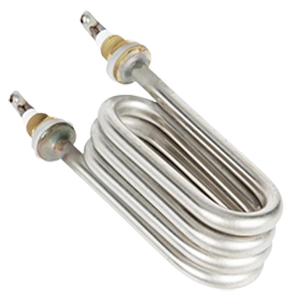
Tubular (Sheathed) Elements
Commonly known as calrods, these consist of a coiled Nickel-Chromium (Nichrome 80/20) resistance wire centered inside a heavy-duty metal alloy tube. The remaining void is filled with high-purity Magnesium Oxide (MgO) powder, which serves as a critical dielectric insulator with exceptionally high thermal conductivity. The tube is drawn down through manufacturing dies to tightly compress the MgO, ensuring rapid, uniform conduction to the outer sheath.
Ceramic Glass Hob Elements
Utilized in modern flat-top commercial ranges, these feature wavy metallic ribbon resistance alloys or high-intensity halogen lamps mounted directly beneath a durable glass-ceramic surface. They transfer energy rapidly via direct conduction and short-wave infrared radiation, offering a seamless, easy-to-clean cooking surface.
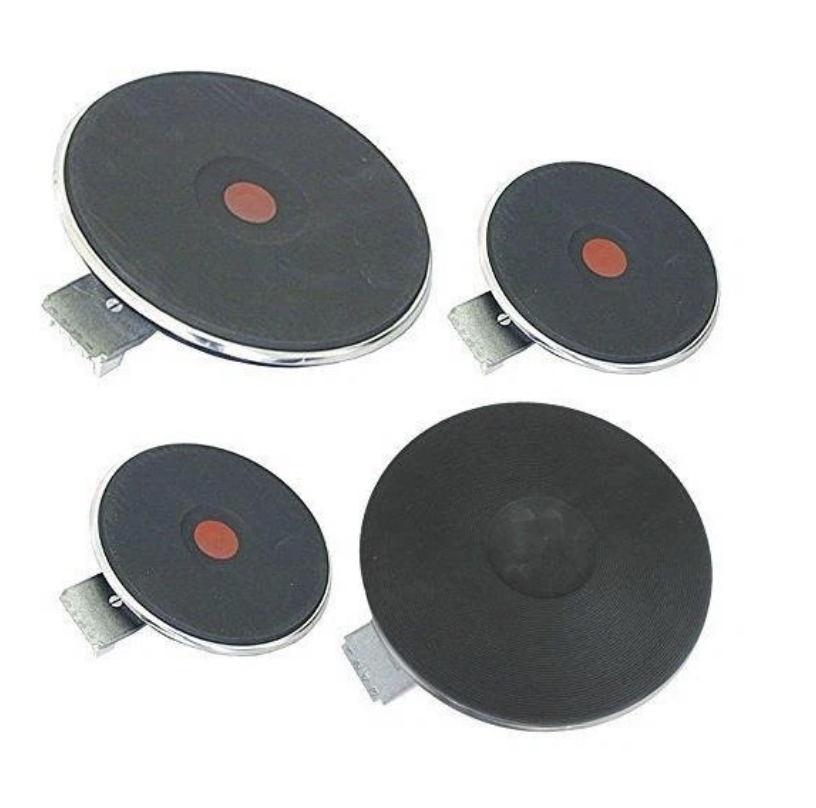
Solid Cast Iron Hot Plates
Traditional, heavy-duty round plates where the resistance coils are completely embedded inside a dense cast iron disc. While they exhibit slower initial heat-up times, their immense thermal mass offers incredible heat retention and structural stability for massive, high-volume commercial stockpots.
2. Key Engineering Specifications for Procurement
Before initiating an RFQ, engineering and procurement teams must align on three foundational material properties that govern Cooker Heating Elements performance and life expectancy:
- Sheath Metallurgy:
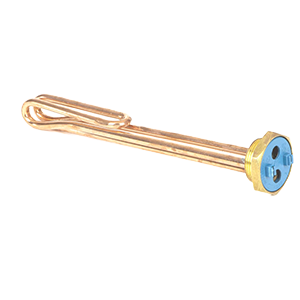
- Copper/Incoloy 800/840: Best for immersion boiling applications due to superior scaling and high-temperature oxidation resistance.
- 304/316 Stainless Steel: The industry standard for dry air-convection baking and food-safe commercial oven interiors.
Watt Density: Calculated as the electrical power output per unit of surface area (W/in2 or W/cm2). High watt-density elements heat up fast but require robust airflow or direct liquid contact to avoid thermal runaway and premature burnout.
Moisture Sealing: Because MgO powder is highly hygroscopic (moisture-absorbent), the terminal ends of the elements must be hermetically sealed with silicone rubber, resin, or technical ceramic beads to prevent electrical tracking and short circuits during washdown cycles.
3. The Definitive RFQ Framework for Cooker Heating Elements
When submitting a Request for Quotation (RFQ) to technical manufacturers, vague terms like “standard stove loop element” will result in delayed bids or incorrect parts. Your RFQ should be structured into clear sections to ensure zero-deviation compliance from prospective bidders.
Use the checklist below to structure your technical data packet before sending it out to your vendor base:
Technical Specification Checklist
| RFQ Requirement Category | Essential Details to Include | Common Pitfall If Omitted |
|---|---|---|
| Electrical Load Profiles | Exact Voltage (e.g., 240V, 480V 3-Phase), Wattage, and Tolerance (typically ±5% to ±10%). | Elements pull incorrect current, blowing industrial control breakers. |
| Physical Geometry & Fit | 3D CAD Models (.STEP) or detailed blueprints indicating terminal spacing, bend radii, and mounting flange placement. | The element structurally interferes with the oven chassis or interior baffles. |
| Operating Environment | Maximum continuous operating temperature, exposure to acidic foods/cleaning chemicals, and heating medium (dry air vs. liquid immersion). | Corrosion or rapid material degradation breaks the outer sheath within months. |
| Terminal Configurations | Terminal pins, screw lugs, flag terminals, or integrated fiberglass insulated lead wires (include length). | Field technicians cannot wire the unit into the existing control harness. |
| Compliance & Logistics | Regulatory safety markings (UL, CE, NSF for food zones), target order quantities (MOQ tiers like 100, 500, 1000 units), and maximum acceptable lead times. | Incoming shipments get flagged by safety compliance auditors or cause assembly line stoppages. |
4. Evaluating the Vendor’s Proposal
When proposals return, remember that the lowest quote isn’t always the most cost-effective. Evaluate your bids across two critical criteria:
- First-Article Inspection (FAI): Ensure the vendor guarantees a sample run for physical dimension verification and dielectric breakdown testing before launching full-scale production.
- Total Cost of Ownership (TCO): Weigh the raw unit price against the element’s rated service hours. A stainless steel or Incoloy element that costs 20% more up front but lasts twice as long as a budget carbon-steel alternative will significantly slash field warranty claims and protect your brand’s reputation for reliability.
Hot Plates /Drum Heater/ EGO hot plate https://www.egoproducts.com/en/products/product-overview
7.5″ -1500w hot plate
6″ – 1000 watts hot plate
9″ – 2200 watts hot plate
9 inch – 2100 watts hot plates
9 inch – 750 watts hot plate
7.5 inch – 750 watts hot plats
6 inch – 1200 watts hot plate
6 inch -1220 watts hot plats
EGO Hote Plate
EGO Hot plates 11.22454.237
EGO 10.54111.014 , EGO 11.33370.247 , EGO 18.14463.196, EGO 10.58111.004, EGO 11.33370.248, EGO 18.14463.197 , EGO 10.54113.034, EGO 11.33460.341, EGO 19.14453.002, EGO 10.51213.094 , EGO 11.33460.344, EGO 12.18463.198, EGO 11.22454.237, EGO 11.33470.244 , EGO 18.18453.002, EGO 11.22454.238, EGO 11.33470.245, EGO 18.18463.018 , EGO 11.22454.264, EGO 11.33470.247, EGO 18.18463.194, EGO 11.22454.266 , EGO 11.33470.194 , EGO 18.18463.198 , EGO 11.33454.335 , EGO 11.33470.195, EGO 19.18463.040, EGO 11.33454.336 , EGO 11.33470.196, EGO 12.22453.018 , EGO 11.33454.239, EGO 11.63471.111, EGO 12.22454.484, EGO 11.33454.246, EGO 11.63471.112 , EGO 12.22463.019 , EGO 11.33454.247, EGO 11.63471.114 , EGO 13.22453.002, EGO 11.33454.248 , EGO 11.63471.145, EGO 18.22453.001, EGO 11.33454.249, EGO 18.11453.002, EGO 18.22453.002, EGO 11.33454.338, EGO 18.14453.002, EGO 18.22453.018, EGO 12.30454.008 , EGO 18.22463.018, EGO 18.22463.014, EGO 12.30454.009, EGO 18.22463.019, EGO 12.30454.195, EGO 19.22453.002
Dia145, 1000Watts/230Volt
Dia-145, 1500Watts/230Volt
Dia180, 1500Watts/230Volt
Dia180, 2000Watts/230Volts – 400Volt
Dia220, 2000Watts/230Volts – 440Volt
Dia220, 2600Watts/230Volts – 440Volt
Dia300, 3000Watts/230Volts – 440Volt
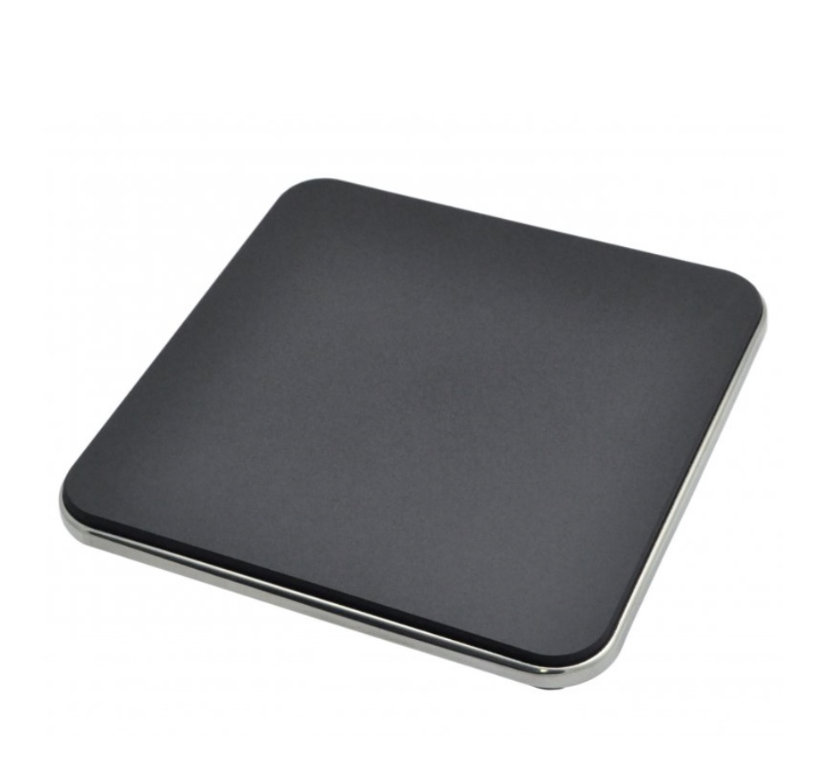
Square 220×220, 2600Watts/230Volts – 440Volt
Square 300×300, 3500Watts/240Volts – 400Volt
Square 300×300, 4000Watts/230Volts – 440Volt
Square 610×305, 5000Watts/230Volts – 440Volt